Innovation and Expertise

ETABLISSEMENT PAU LACQ
Driving the performance of the Company’s supercomputers and developing software capable of simulating complex physical phenomena in the field of energy – this is the job of Elies Bergounioux, a HPC (High Performance Computing) engineer.
He arrived at CSTJF in Pau during the launch of Pangea 1 and has observed all the changes up until today. His mission is twofold. On the one hand, guaranteeing the continuous performance of supercomputers and anticipating their obsolescence. And on the other hand, designing software capable of simulating complex physical phenomena for the Exploration-Production field, as well as for new uses, particularly in relation to renewable energy. Read on to find out more about mathematics and supercomputers!
TotalEnergies’ HPC line is named “Pangea” after an original, giant supercontinent, symbolising power and a nod to geology and geoscience. Diego Klahr has worked as a HPC Senior advisor at TotalEnergies in Pau since 2011. In 2013 he piloted the launch of Pangea 1 and still monitors its developments to this day.

"HPC is the Formula 1 of IT. Everything is made-to-measure, produced on a small scale and constantly ‘fine-tuned’. For each circuit (datacentre, algorithm), we have to adjust the settings, optimise the engine according to the data, constraints and requirements, and make corrections in real time. The computing codes are the fuel which powers these precision mechanics. In terms of speed, we only see supercomputers at the top of the podium, but behind them lies a team and, above all, strategic decisions!”

Elies, can you sum up your career in a few words?
Elies Bergounioux: After my final year internship as an engineer at CSTJF in Pau in 2009, I joined INRIA as a research engineer before returning to TotalEnergies Pau in 2011 as an engineer/designer/developer, specialised in high-performance computing (HPC). My arrival coincided with the launch of Pangea 1. I was therefore able to follow its developments over the generations and I am now a HPC environmental specialist.
What are the missions of the TotalEnergies HPC department?
E.B.: One of the main responsibilities of our department is to ensure that TotalEnergies’ various supercomputers (nearly a dozen) are working correctly, with a high level of performance. Our challenge is to maximise the potential of these computing giants. Our teams aim for operational excellence with machine availability exceeding 99%. In addition, these technologies are changing very quickly: we need to constantly plan for renewals to prevent any loss in competitiveness and maintain our supercomputers at optimum level.
We are also developing and optimising scientific software designed to operate on our supercomputers, particularly on Pangea 4. The aim is to transform computing power into exploitable knowledge. We simulate complex physical phenomena using mathematical equations. In a reservoir simulation, for instance, we model the flow of fluids in the subsurface to inform industrial decisions.
Speaking of which, what is the actual purpose of supercomputers such as Pangea?
E.B.: When it was launched in 2013, Pangea 1 was mainly used by seismic imaging for the Exploration-Production branch of the Company, dedicated to oil and gas. The idea was to carry out an ultrasound of the Earth, on hundreds of square kilometres. This requires considerable computing power to identify new oil fields in the subsoil. Another area which requires significant computing resources is reservoir simulation, which is based on another logic: optimising production and improving the yield of existing oil fields. In 2016, Pangea 2 was ramped up to support new, more advanced seismic algorithms which use greater computing power but offer higher-quality seismic images. Then Pangea 3 increased its computing power sixfold and introduced new uses, particularly with artificial intelligence.
The creation of the OneTech branch led to greater computing needs. Ultra-compact and multipurpose, Pangea 4 meets a range of applications, particularly linked to renewable energy, the geological storage of CO₂ and the reduction in greenhouse gas emissions. With a power of 1.4 petaflops (i.e. 1.4 thousand trillion operations per second!), Pangea 4 is equivalent to connecting 5,000 personal computers simultaneously. And for the same power, it consumes four times less than its older brother, Pangea 2. Pangea 4 also comes with Pangea@Cloud, our first supercomputer hosted in the cloud, which offers us the flexibility to upgrade our computing capacity. Today, Pangea 4 is used by around one hundred TotalEnergies users worldwide and performs nearly 100,000 computing operations on a daily basis.
An example of a successful project with Pangea 4
E.B.: We recently used Pangea 4 for an offshore windfarm project in Germany. We launched a series of simulations via our GRIF software suite to test various scenarios and safeguard our technical decisions. This helped us optimise the design of the windfarm, leading to significant financial gains and improving the management of maintenance cycles.
More generally, the computing capacity of our various HPCs helps to reduce uncertainty and avoid costly errors. They can confirm the existence of a reservoir, or, on the contrary, prevent the boring of dry wells. Seismic imaging, for instance, has been a key factor in the success of the exploration and production stage on Block 32 in Angola, where only state-of-the-art imaging techniques, made possible thanks to Pangea 3, were capable of producing images of oil fields located beneath salt canopies.
How do you work with the other teams?
E.B.: We are constantly collaborating since our role is not to develop tools for ourselves but to put computing power at the service of our various activities. This requires close ties with users: understanding their needs, being aware of operational constraints and sticking to in-the-field realities to offer a supercomputer which meets usage requirements as best as possible. We are working with our R&D team in Houston and transversally with all of the teams at CSTJF, where all our supercomputers are hosted. But our scope is international: our users are in the United States, Europe, Africa, etc.
Today, uses are expanding, driven by all of the Company’s activities. This compels us to be extremely agile. Cybersecurity is another key topic, and we are working closely with the dedicated teams. We have worked hard and are continuing to strengthen our protection systems to limit the risks of intrusion and be ready to respond in case of an attack.
What do you like about your job?
E.B.: It is at the crossroads of several spheres: IT, maths and in-the-field operations. We have access to some of the world’s most powerful infrastructure which we use to resolve very tangible in-the-field issues. What I like is this permanent gateway between scientific complexity and real utility. Each computing operation serves a purpose. New challenges are emerging with artificial intelligence, including growing demand in computing power; we need to keep on top of this revolution which has arrived and is changing very quickly. I’m thinking in particular of the HSE (health, safety, environment) project in Papua New Guinea which our department is highly involved in. We use AI models to anticipate rapid rises in water levels and alert local inhabitants of the risk of flooding. Here we are no longer in theory and abstraction: it is a very real matter… and it can save lives!
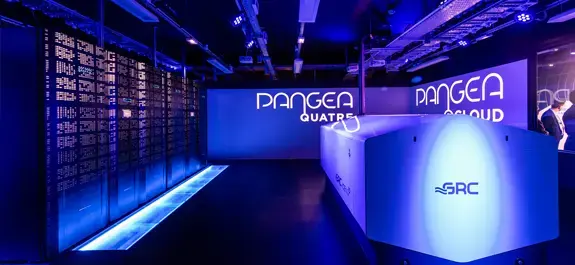
Pangea: Modeling, simulating, and making decision-making easier
In 2013, when TotalEnergies installed its first industrial supercomptuer at the CSTJF in Pau, it needed a name. Since the 1980s, all the Company’s computers were named after islands...

Mathias Days: AI and simulation at the heart of energy challenges
This is TotalEnergies’ main scientific event, dedicated to applied mathematics, scientific calculations, HPC and AI, and a key highlight for employees at the Pau site.
CSTJF: behind the scenes of excellence
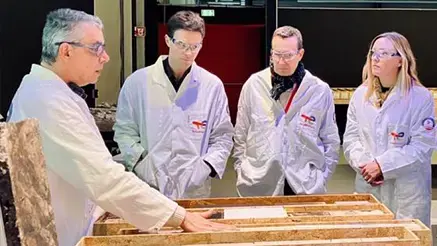
Every year, hundreds of visitors - VIPs from all over the world: governmental authorities, national companies, different peers and partners, students, etc. come to tour the TotalEnergies Center in Pau.