Innovation and Expertise

ETABLISSEMENT PAU LACQ
Benjamin Brocart, an engineer at the CSTJF, and his team took part in developing an innovative solution for connecting oil & gas hoses to tankers in safer conditions. The method won the Jury’s Award of TotalEnergies’ OneTech branch’s in-house innovation contest called WhatIF. Here is the lowdown.
Seizing the opportunity of the Company’s innovation contest, WhatIF

When Benjamin Brocart came across the call for applications to take part in the WhatIF innovation contest (see insert), he jumped at the opportunity. He joined TotalEnergies in 2002 and worked in Research & Development before joining teams in the field, in Angola, Australia, and Gabon, among others. He returned to Pau in 2020 and has since worked at the CSTJF, in the department specializing in Liquefied Natural Gas (LNG) installations.
“Coming up with an innovative technical solution that meets one of the Company’s needs, working with a multidisciplinary team – including coaching, discussions with experts to prototype and give life to innovative ideas through collective intelligence – it was a unique opportunity... I’ve always enjoyed trying out new things and this in-house innovation contest was a chance to work again on a concrete subject that has a real impact in the field,” he tells us.
The central theme of the 2026 edition was innovation and safety
The participants, from across the globe and from different professions within the Company, were presented with eight topics, reflecting the specific concerns of the operations teams. “My team included employees based in Le Havre, Paris, Pau, and Nigeria. Each member provided their expertise and their own approach to the problem at hand. One person had in-depth knowledge of HSE, another of offshore vessels, another of the context in Nigeria. This diversity is what enabled us to make headway.”
The team, called Atlantic, chose by lot the subject they would be working on: the connection of hoses used to load oil onto tankers, the objective being to secure the process to reduce risks to a minimum.
Investigation in the field
Before looking for a solution, the team conducted an investigation in the field to better understand the issue at hand. “During this first phase, we were able to rule out some ideas. We refocused our thought process on one principle in particular, which was to move all hose connection operations out onto the water, thereby making sure that none would take place in the areas where teams are present.” An experiment conducted in Brazil provided a first point of reference and strengthened the team’s conviction that they were on the right track. “We took inspiration from this approach to develop our own solution.”
A serious game to train the teams
To step up the safety aspect, Benjamin and his team created an awareness pack designed to get the crews ready for change management. “Among other things, we imagined a serious game (a simulator designed as a video game) to remind the crews of best practices before they start operations. The crews speak several languages and don’t necessarily perform this type of connection operation on a regular basis. After several weeks at sea, some safety gestures can become less of a reflex.”
The project won the Jury’s Award and could shortly receive further support from TotalEnergies’ Innovation Accelerator, which could help it on its way to being implemented in the field and deployed on a larger scale.
“Innovation doesn’t always mean inventing something from scratch. It can also be derived from a practice observed elsewhere, fitted to a different context, and improved collectively. The main thing is that it meets a real operational requirement,” explains Benjamin Brocart. “At TotalEnergies, we want everyone to be able to turn a promising idea into a tangible solution. The aim of the Innovation Accelerator is to remove barriers, accelerate the experimentation process, and give the projects the best possible chance to prove their worth,” concludes Bjorn Viguerie, in charge of the Innovation Accelerator of TotalEnergies’ OneTech branch.

Benjamin Brocart - TotalEnergies, Sébastien Leplat - TotalEnergies, Hélène Mathias - TotalEnergies, Stéphane Jacky Monnier - TotalEnergies, Matthieu Perreard – Director | Entrepreneur and consultant, Inskip, Cyril Hasson - Head of Prototyping & Technologies, X-Novation Center, École Polytechnique.
WhatIF in short
WhatIF is an in-house innovation contest at TotalEnergies. It is an opportunity for employees from different professions, branches, and countries to tackle technical, technological, and industrial challenges.
Its ambition is to stimulate collective intelligence and turn employees’ creativity into tangible solutions that will help ensure the safety of people and goods, as well as support industrial performance and the energy transition.
Forty or so people took part in the 2026 edition. After a conception phase, coaching sessions, and a bootcamp for project maturation, the four finalist teams presented their solutions to the jury.

Predictive Maintenance: TotalEnergies RAID at the forefront
In industry, the reliability of rotating machines is essential in terms of safety, the environment and performance. That’s why in Pau, the RAID team monitors signals from thousands of sensors for the Company.

Drilling & Wells: anticipating risks and innovating for the environment
The teams at TotalEnergies in Pau strive to reconcile economic, industrial and environmental performance, even under extreme conditions. Interview with Matthieu Pecoits.
TADI, a unique technological tool to detect and quantify methane
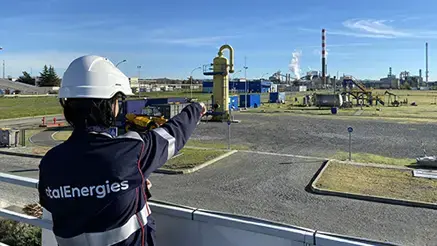
In Lacq, with TADI, the only experimental site of its kind in Europe, TotalEnergies is at the forefront of methane emission detection and quantification. Watch the video to find out more.