Competencies and Professions

ETABLISSEMENT PAU LACQ
The Maison pour la science (Science Center) of the French region of Aquitaine has added the course “Current and next-gen energies” to its training offer. It is designed for secondary education teachers under the Bordeaux Education Board. The aim is to provide them with the keys for understanding modern-day energy stakes drawing on scientific, technical and societal aspects such as the energy mix, the energy transition, technological innovations, not forgetting scales and measurements, uses and impacts. Owing to input from researchers, experts, and industrial players, the training course is in keeping with the ambition of delivering in-depth, up-to-date and practical training, to bring scientific culture to younger generations.
It is in this context and thanks to the commitment of Hugues Greder, an R&D engineer, along with other participants from TotalEnergies’ Pau Site, that the course is taking place at the CSTJF.

"We share a factual and nuanced viewpoint of the challenges the sector is facing: meeting growing energy needs while stepping up emission reduction; developing renewables and low-carbon solutions, while continuing our efforts to innovate and be competitive in our long-standing activities,” Hugh explains. “Our aim in participating is also to nurture dialog and knowledge transfer; to provide teachers with facts obtained from our experience in the field, to enhance their teaching practices and encourage informed debates on the energy choices that await us now and in the future."

Dr. Cecilia Sambusiti, a process engineer specialized in biogas, is one of the volunteers from TotalEnergies giving some of her time to help people gain greater understanding of these issues. Energy choices often involve making technical, economical and societal compromises.
"The energy system is undergoing a major upheaval, but the transition itself is, first and foremost, gradual and multifaceted. Current and next-gen energies are not diametrically opposed but rather co-exist and complete one another in order to meet growing energy needs while reducing the environmental footprint. Technological innovation, improved energy efficiency and a wide range of solutions are key levers to a successful transition."
According to Cecilia, who wishes to share a practical and factual point of view based on tangible examples taken from her professional experience, the training course gives pride of place to discussions with the teachers, sparking particularly rich debates, in which the speakers learn as much as the participants.
We spoke to Marie Fauquembergue, an engineer working for the Maison de la science in Aquitaine, who is organizing the course.
What are the main educational goals of this course and what are the key takeaways you want teachers to be able to pass on to their students?

Marie Fauquembergue: Since 2019, school programs have really laid emphasis on raising awareness of sustainable development and global warming in particular. It’s a multi-disciplinary subject that concerns science, history-geography, and language teachers, as well as school library media specialists. We start the course by going back over the concept of energy: it’s essential to know all about its different forms and transformations, and to have some idea of scales and measurements in order to properly understand the stakes of the energy transition. We then take a look at different aspects: is an all-renewable mix really possible? How can we reduce the carbon intensity of some of our energy sources? The fact that it is important to move on from coal to natural gas and from there to biogas for example. How can we achieve net zero? Is CCUS (carbon capture and storage) one way of getting there? Alongside the scientific debates and insights, we organize highly factual workshops designed so that teachers can later reuse the content with their students. For example, one of our activities is based on the use of the Electricity Maps website that compares different choices of electricity mixes made by different countries.
How does the presence of speakers from TotalEnergies help provide a more in-depth understanding of current and future energy stakes?
MF.: As TotalEnergies is developing competencies to further diversify its energy sources, participants from the Company can provide advanced scientific insights on various subjects such as methanization and CCUS. Even though this solution should not replace the efforts made to step up decarbonization and energy sobriety, it does however appear now in all net zero scenarios, and it is therefore essential to understand the techniques and constraints involved.
How is this type of training course received by teachers and what are the most frequently asked questions as regards energy topics?
MF.: The teachers are delighted to be able to visit TotalEnergies’ Jean-Feger Center. They are always made to feel very welcome, as evidenced by the feedback they give us in our satisfaction survey. They appreciate the wealth of insights and discussions. The speakers are often praised for their integrity. Here is an example of some of the feedback received: “The presence of researchers who know their subject inside out and are able to share it with enthusiasm and simplicity is a real plus.” Among the most frequently asked questions is that of the potential danger of subsurface CO2 storage. The teachers are often surprised by the huge energy and methane losses that can occur throughout a chain. They are also curious about many geopolitical issues that are new to them.
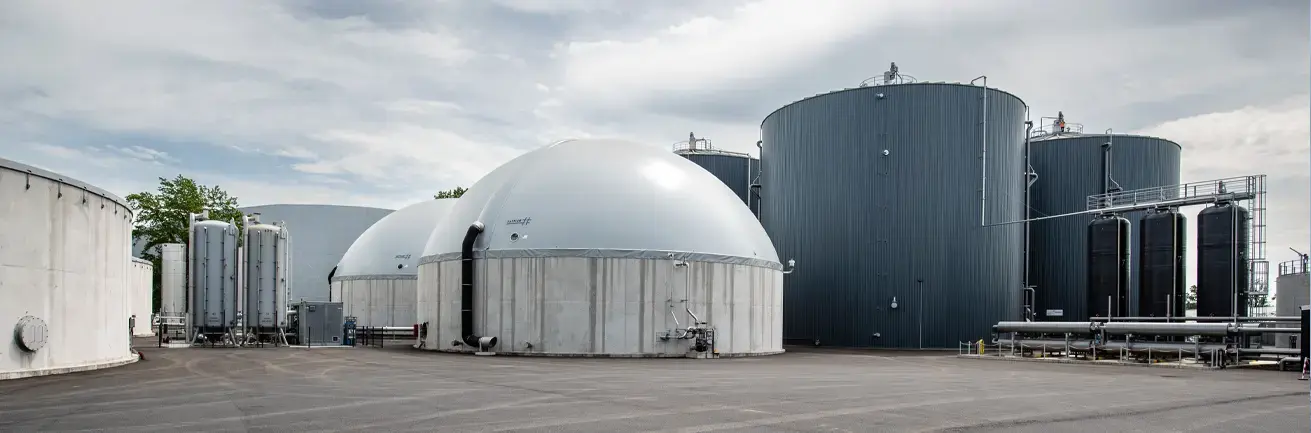
Focusing on biogas, a local energy source
In 2023, TotalEnergies started up Biobéarn, its eighteenth biogas production unit, in Mourenx in the Pyrénées-Atlantiques, France.
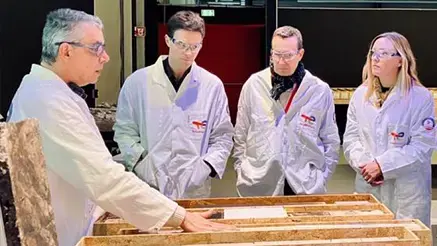
CSTJF: behind the scenes of excellence
Every year, hundreds of visitors - VIPs from all over the world: governmental authorities, national companies, different peers and partners, students, etc. come to tour the TotalEnergies Center in Pau.

CO₂ geological storage
The R&D team at TotalEnergies has been working for over twenty years on the development of CCS (Carbon Capture and Storage) to reduce its CO₂ emissions and those of its clients.