Innovation and Expertise

ETABLISSEMENT PAU LACQ
Hugues Greder is a research & development engineer at TotalEnergies on the Pau Site, at the CSTJF. He has clocked up extensive experience in energy, innovation, and technological development and liaises between the industrial and the academic worlds. He is involved in a number of scientific and academic partnerships and actively contributes to disseminating scientific and technical culture among students and professors. He is convinced that innovation, cooperation, and knowledge-sharing are all essential to tackle the major energy challenges, and strives to develop partnerships between TotalEnergies, research bodies, and institutions of higher education. He defends an approach centered on dialog between disciplines, international openness, and the promotion of knowledge that will help develop the energy solutions of the future.

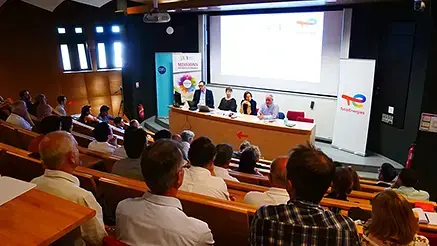
Hugues took part in the International Stirling Engine Conference (ISEC) that brings together eminent professors and researchers from the industry and academia, from all over the world. And what was the aim of the 21st edition that took place at the UPPA (the University of Pau and the Adour region)? To share the most recent advances made on the Stirling engine and on other types of hot air engines, including with the general public. TotalEnergies is greatly interested in these technologies as they are fully in line with its technological ambition, which is to achieve excellence in key technologies for the energy transition. These innovations represent a promising way forward for reducing the emissions associated with industrial heat production, while improving sites’ energy efficiency.
Why did TotalEnergies’ R&D division choose to support and participate in the ISEC 2026 held in Pau?
This year, the UPPA was selected by the Stirling International Association to hold the conference on its Pau campus. As the UPPA has been a trustworthy partner of our R&D division for more than 30 years and has close ties with the CSTJF, contributing came as an easy decision. Taking part in the activities of the various local players, academic ones in particular, has been written into the Company’s DNA for decades. The UPPA is a highly valuable player in R&D, and our partnership includes foundational chairs, shared laboratories, and research units in areas ranging from carbon capture and storage, to noble gases, to sustainable development, not forgetting AI, numerical simulation, image analysis, and supercomputers. Many of our employees also give lectures at the UPPA in order to pass on our experience of the energy challenges of the future to younger generations. Above all, forming research relationships between entities means exchanging viewpoints and working on a daily basis to generate new ideas together. This international conference is once again proof of this.
What themes or technological advances presented during the conference do you think are of particular interest to the energy sector today?
The conference looked into particular thermodynamic cycles, namely Stirling and Ericsson, which are currently used only in the military and space domains. TotalEnergies is a major player in the field of thermodynamic machines, particularly in terms of our gas turbines designed for the offshore and of our combined cycle power plants, which, along with batteries and intermittent renewables, are key elements for ensuring a continuous supply of carbon-free electricity worldwide. As for Stirling engines, they could lead to the development of very high temperature industrial heat pumps (HTHP). These industrial HTHPs, currently still in the test phase, could then possibly be used to decarbonize heat generation in our refineries, a crucial factor for the energy transition phase.
In what respect do the topics addressed at the ISEC interconnect with the research and concerns of the CSTJF teams?
Energy efficiency and decarbonization are both topics that matter a great deal to TotalEnergies’ R&D teams. They contribute to developing and evaluating technological solutions designed to reduce the emissions of industrial operations and support the transition to increasingly effective energy systems that emit less and less.
Among other things, the conference was an opportunity for us to meet a start-up that has three fully-functioning HTHP demonstrators in Norway. Our research centers and our representatives in Stavanger will immediately begin work with the start-up to assess its technologies and possibly define actions in common for the future.
What is your takeaway from the 2026 edition and what message would you like to pass on to students interested in energy and innovation professions?
In a world that is breaking up before our very eyes, this conference brought together 60 or so experts from countries all over the globe: Taiwan, South Korea, Japan, the UK, Germany, Turkey, Norway, Italy, the USA, Canada and Spain (which will be organizing the next conference in Madrid in 2028). The President of the Stirling International Association, who is from Taiwan, made a point of referring to the notion of “family” that unites scientific researchers from all over the world to help humankind move ahead. The online upload of an open-source information library on thermodynamic Stirling machines by NASA was a particularly good illustration of this notion. And another was given by Matthieu Doubs, a passionate independent scientist, who open-sourced all the information needed to build a Philips MP-1002-CA Stirling engine. Using his own funds, he re-created all the plans in digital format by retro-engineering. This will enable anyone who wants to work on Stirling cycles to be able to do so straightaway and at a reasonable cost.
The message I’d like to pass on to students is straightforward: be inquisitive, keep an open mind and don’t hesitate to combine disciplines. It’s by bringing together science, engineering, digital solutions, the industry, and international cooperation that we’ll develop tomorrow’s energy solutions. The challenges we face are huge, but they are also a source of amazing opportunities for those who want to innovate, learn, and contribute to building a more sustainable energy future. Innovation is also born from the variety of backgrounds and viewpoints that go into it.

Current and next-gen energies: a down-to-earth training course for teachers at the CSTJF
The energy transition debate is not just a scientific one, it also raises economic and geopolitical issues. The Maison pour la Science (Science Center) gives the general public an opportunity to meet with industrial players like TotalEnergies so they have key elements for understanding the issues at play.

Drilling & Wells: anticipating risks and innovating for the environment
The teams at TotalEnergies in Pau strive to reconcile economic, industrial and environmental performance, even under extreme conditions. Interview with Matthieu Pecoits.
UPPA frame contract: co-developing sustainable solutions with regional talents
R&D: find out how TotalEnergies and the UPPA are co-developing sustainable solutions with help from high-potential regional scientists.