Innovation and Expertise

ETABLISSEMENT PAU LACQ
At TotalEnergies, we firmly believe that young people are the driving force of our regions and a fantastic lever of change. This is why the Company is taking action alongside the people who are inventing new ways of learning and of looking at the working world. It was with this in mind that the partnership with the Pioneers program, led by Le Connecteur (coworking space) in Biarritz, was initiated several years ago.

This open innovation program was imagined as a life-size testing ground; for eight weeks, it brings together students from different backgrounds – such as engineers, designers, salespeople, digital experts – and local companies to investigate specific innovation issues.
The human aspect, more than the solutions investigated, is at the heart of the challenge. With Pioneers, the students are led to tackle the demanding world of work head on: they learn to cooperate with people they did not choose, compare their ideas, work outside the academic framework, and face the reality of corporate life before they have even had a chance to adopt its codes. For TotalEnergies, it is an opportunity to benefit from unbiased, fresh perspectives; to work with people capable of coming up with new ideas that we would never have thought of in-house, and of nurturing a more open, collective, and dynamic innovation.
The partnership does not address a specific need but fits in with a state of mind: believing in young people, trusting them, and building experiences where people grow individually and together.
TotalEnergies’ pilots for the 2026 edition, Pierre-Emmanuel Lardin, Innovation Accelerator Support Leader (on the left in the photo), and Nicolas Petit, Senior Innovation Project Engineer (in the middle), give us the lowdown.
In addition to the deliverables and concepts developed, what are you seeking to pass on to the students taking part in the Pioneers program ?
Pierre-Emmanuel Lardin – PEL: For eight weeks, the students face a real collective challenge: the aim is to boost their confidence and help them realize that despite their young age, they are able to provide real solutions to problems that we employees, for all our experience, have not yet managed to work out. Our ambition is also to encourage them to be bold, to take initiatives and to think outside the box, even if it means challenging us!
Nicolas Petit – NP: I would say that our goal is to provide them with the fundamentals for working as a group by developing certain soft skills that schools do not necessarily study at length, such as kindness and active listening, and to pass on feedback about working as a team in a company so that they may use it later on when they enter the professional world.
The program imposes teaming up people with very different profiles and backgrounds. In your opinion, what do the students learn from collaborating with a team they did not choose?
NP: In not choosing their teammates, the students first have to accept the prerequisites of working as a group in a professional environment. It also means expanding their comfort zone, as they are faced with ways of thinking and working that are completely unlike their own. For season 3 of the Pioneers, our team was made up of students in architecture, business, and engineering – so really very different worlds and thought processes. Such a wealth of profiles means we can come up with more pertinent solutions.
PEL: It’s true that because the students all have very distinct training paths, they naturally tend toward markedly different approaches, which reflects the same sort of diversity encountered in the corporate world. This is a way of preparing them for it. Although they become aware throughout the program that things are sometimes easier said than done, they still learn to build together, while taking on board and complying with our constraints and requirements.
As TotalEnergies employees working in a highly technical environment, can you tell us how the outlook of young people, not yet shaped by corporate culture, shakes up habits, certainties or even limiting beliefs? Do you have a significant example?
NP: They do so just by using their own codes, totally different to ours, and by using the thought processes specific to their generation, rather than those of our slightly older one. The solutions obtained as part of the Pioneers program are therefore more likely to meet the expectations of new generations of employees or future hires. From our point of view, this makes a lot of sense as the goal is to have our employees embrace the culture of innovation.
PEL & NP: We both have the same significant example: we were surprised by how the students addressed the issue we put to them: "How can gamification put the fun into innovation integration and make it go viral?"
As good old engineers, we had started imagining highly complex concepts based on the metaverse and gamification tools. Finally, they chose to inject a solution to their own issue – screens – into the issue we were trying to solve, i.e. innovation integration.
Based on the observation that many smartphone users, themselves included, tend to doomscroll – a compulsive habit of consulting often anxiety-inducing information – their intuition was then to take advantage of this practice to make it a boon instead of a bane, by turning doomscrolling into smartscrolling. We never would have thought they would have such a clear-headed view of their own habits or that they would seek to redefine them like this!
What do these young people have to offer you, experienced professionals? And in return, what do you think you have to offer them that they would not find elsewhere?
PEL: They offer us new, external points of view and challenge a number of our practices and automatic reflexes that sometimes warrant being called into question. They also enable us to take a step to one side, outside of our informational bubble, a real source of innovation. From our point of view, the Company’s international presence gives them a real chance to play on the worldwide stage. The project they worked on could potentially be used by thousands of employees across the world. Through the program, they also discover issues encountered by other companies in the region.
NP: Although we both have an innovation background, these young people offer us a fresh take on things, an open-mindedness as regards our issues that is different to that of TotalEnergies, and a real push forward. It’s a very rewarding exchange of energies. Our role as pilots goes way beyond the problem we put to them: the human experience in the Pioneers program is a key aspect. For example, it’s not always easy to manage frustration when you’re not used to working as part of a group, cut off from the rest of the world, for eight weeks; our role was to pass on a few tips to help them succeed.
What makes the inter company dimension so essential nowadays?
NP: It’s essential for several reasons. First, it helps understand how a common issue can be perceived or solved differently depending on the company. This year, EDF showed great interest in our subject, and we, in turn, thought that the solution found by the students for EDF’s issue was really inspiring and could be transposed to TotalEnergies. This type of dynamic ensures that, as well as other pilots, we also meet people from the outside who share an interest in these topics. And discussions always continue well after the Pioneers program has come to an end.
PEL: This type of event, which fosters discussions with other businesses, makes us aware that many of us face the same types of problems and challenges. A case in point is our challenge of promoting innovation integration among employees, shared by several of the companies encountered during the Pioneers. Nowadays, everything is evolving extremely fast. The current artificial intelligence revolution is causing an exponential acceleration of this trend, and we are doubtless entering an era in which the key will lie in our ability to detect and rapidly deploy emerging innovations outside the company. This is exactly why the industrial innovation accelerator program I belong to was created at TotalEnergies in 2024.
If you had to sum up the partnership with Pioneers in one sentence, not as a program, but as a human adventure, what would you say?
PEL: If there can be no innovation without pioneers, there can be no pioneers without students bold enough to wager on human and collective intelligence!
NP: If there can be no innovation without pioneers, there can be no pioneers without students bold enough to wager on human and collective intelligence!
To find out more: Le Connecteur
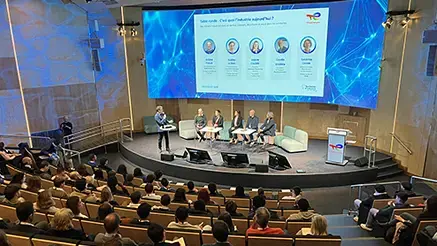
INDUSDAY: a day at TotalEnergies to inspire young people
During Industry Week, 90 students took part in a unique experience at CSTJF in Pau aimed at awakening their curiosity and inspiring them to pursue a career in an innovative and meaningful sector.
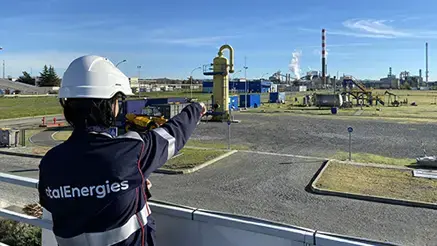
TADI: A test center with international reach in Lacq
The TADI (TotalEnergies Anomaly Detection Initiatives) site, located at the PERL in Lacq, is used to test and qualify innovative gas leak detection and quantification technologies.
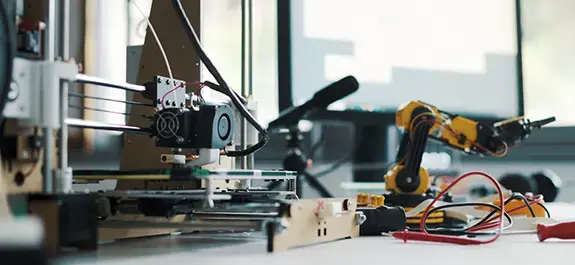
FabLab: Designing, manufacturing, copying, repairing!
Designing, manufacturing, copying, repairing and developing prototypes - using all kinds of materials. Created in 2021 by Laurent Germain, an electronics and IT engineer with a Masters degree in robotics, the FabLab at the CSTJF brings every idea to life.