Innovation and Expertise

ETABLISSEMENT PAU LACQ
The FabLab was created four years ago at the Pau site of TotalEnergies by Laurent Germain, an IT and electronics engineer with a Master’s degree in robotics, and has gone on to play a key role in the Company’s laboratories and subsidiaries. Working alongside Stéphane Martinez, an additive manufacturing specialist, Laurent Germain designs parts that can’t be bought anywhere else and replacement parts for worn components, often for complex projects.
In 2021, the FabLab had several 3D printers, a laser cutter, a digital milling machine and an electronics division. Now, this pioneering duo has not only increased the capacities of FabLab in Pau, with the acquisition of five industrial polymer printers installed in a new dedicated space at the CSTJF, but also launched the roll-out of 3D processing in subsidiaries worldwide. They started with 3D printers installed locally and managed from Pau, then proceeded to provide training programmes on how to use this technology, allowing local operators to develop their skills in their own subsidiaries. The aim: to increase autonomy at sites and make 3D printing become second nature.
This strategy is paying off. In Angola, five polymer machines and a metal printer now operate 24/7 locally. The Pau team helps to produce parts in series, as well as large parts (e.g. UV protectors for infrared sensors, electric motor covers, etc.). New polymer printing technology offering improved mechanical strength completes the offer to meet the latest demands.

"What we are hoping for is that people don’t wait until they have exhausted all other options before coming to us when they encounter a problem. The idea is to make this type of solution become mainstream, with the knowledge that our expertise, our network and our new resources, which are better adapted to the Company’s needs, can help us overcome numerous challenges", Laurent explains.
Laurent and Stéphane also test and qualify new machines for affiliates. Their ambition is clear: to bring 3D printing to the industrial level and create a real community to reduce costs, timeframes, waste and carbon footprints linked to transport. This technology is currently being rolled out in Angola, as well as Qatar, the DRC, Denmark and Nigeria, among other countries.
Meanwhile, the FabLab continues to meet the needs of its in-house clients on a daily basis, applying their creativity and expertise in a diverse number of areas, from printing polymer valves to replace rusty parts to designing a fish larva counting device on behalf of the biodiversity team and helping the CSTJF laboratories! In 2025, nearly 3,000 printing operations for non-critical parts were performed.

"We don’t work alone. We have built a robust network of local makers, who we privilege, as well as national makers. Our knowledge and precise technical language help us to clearly state any problems we encounter and choose the right people to find and implement bespoke solutions", Stéphane highlights.
The FabLab also offers a Repair Shop and a 3D printing service for employees’ personal needs. Here, everyone can learn how to design, model and make parts, programme micro-controllers, build a robot, develop a home automation system and discover augmented and virtual reality. Practice, learning and curiosity are at the heart of the 3D spirit. It is often by bringing daily objects back to life that employees discover the potential of 3D printing and how it can solve maintenance issues in their line of work.
This approach illustrates Laurent’s and Stéphane’s ambition: to familiarise people with new technology so that everyone actively fosters innovation.


Intellectual property: the cornerstone of innovation at TotalEnergies
Galal El Mardeny, Head of the Patents Team at the CSTJF in Pau, sheds some light on intellectual property and his role in protecting innovation, optimizing performance and supporting the energy transition through an innovative patents strategy.
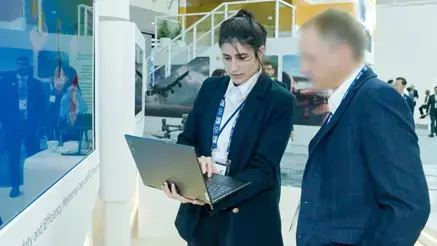
GRIF: When mathematics catalyze the energy transition…
From the TotalEnergies Site in Pau, Maïder Estécahandy leads the GRIF (GRaphical Interface for reliability Forecasting) project. She’s a reliability engineer and decodes a profession where complex calculations play a central role in the context of the energy transition.
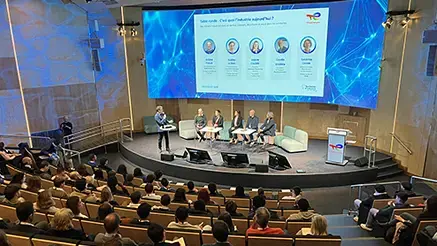
INDUSDAY: a day at TotalEnergies to inspire young people
During Industry Week, 90 students took part in a unique experience at CSTJF in Pau aimed at awakening their curiosity and inspiring them to pursue a career in an innovative and meaningful sector.